


Relevant demand
Campaigns focus on people whose searches show a meaningful commercial intention.
With Google Ads, budget should follow measurable demand and clear conversion goals. We focus on relevant searches, landing-page fit, tracking and continuous optimization rather than simply buying more clicks.
Structure campaigns around commercial intent, relevant search terms, conversion tracking, useful landing pages and controlled budget decisions.
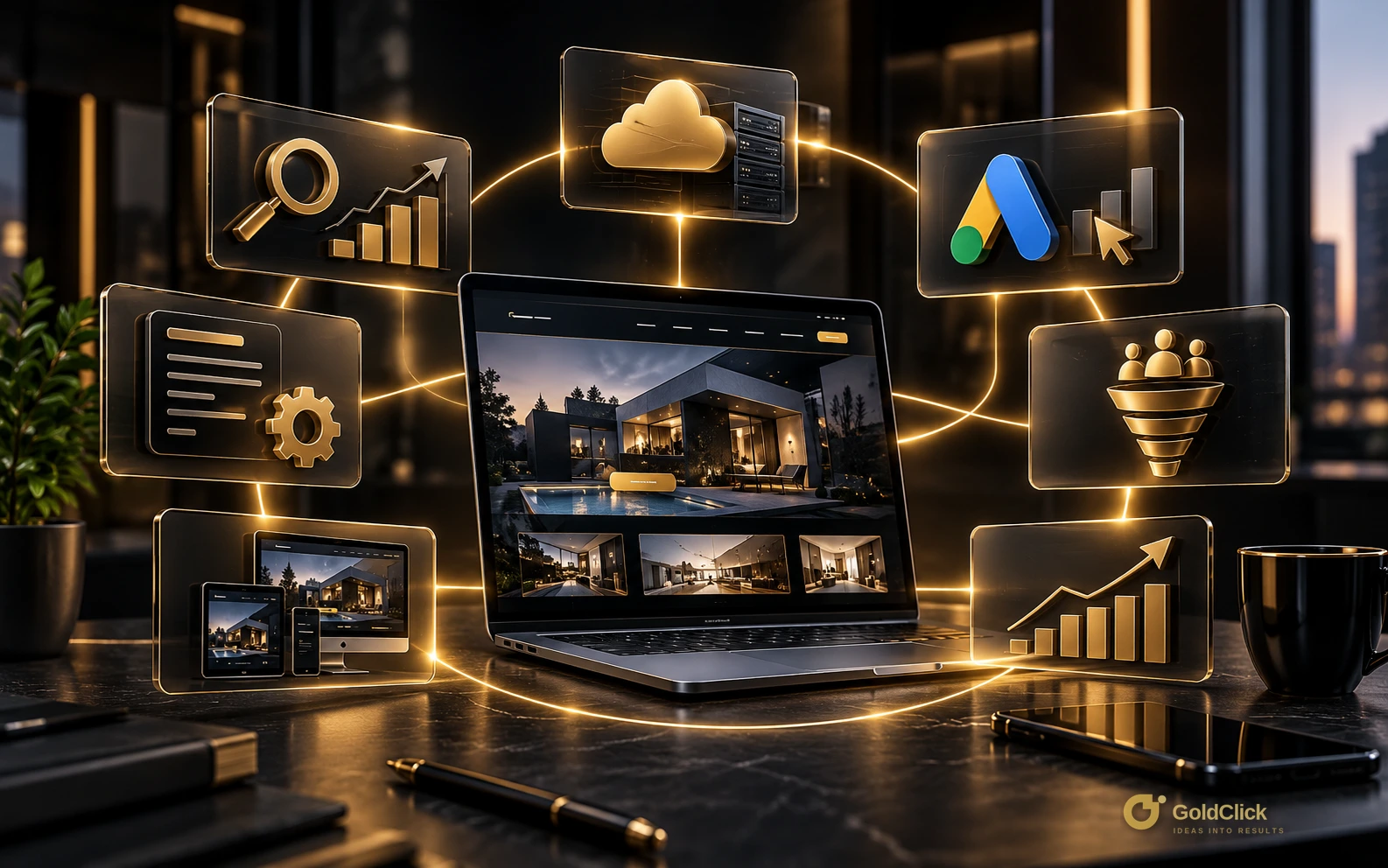
Campaigns focus on people whose searches show a meaningful commercial intention.
Calls, forms and other useful actions should be measured so decisions are based on outcomes.
Search terms, negative keywords, bids, budgets and landing pages need regular review.

We start with what you sell, who should find you and which action matters most.
We define structure, content, visual direction, technical requirements and measurement.
We implement the agreed scope, test it and refine the details with your feedback.
After launch we can continue with SEO, Google Ads, maintenance or content when those activities have a clear purpose.

For Google Ads, we need the business facts that only the client can confirm: the offer, target customers, priorities, constraints and any existing access or assets. GoldClick can then organise the website copy, visual material and technical implementation within the agreed scope instead of asking the client to prepare technical specifications.
Coordinate website, SEO, advertising, content and measurement around the actions that matter to the business.
Final scope and price depend on the actual project. We define deliverables before work starts.
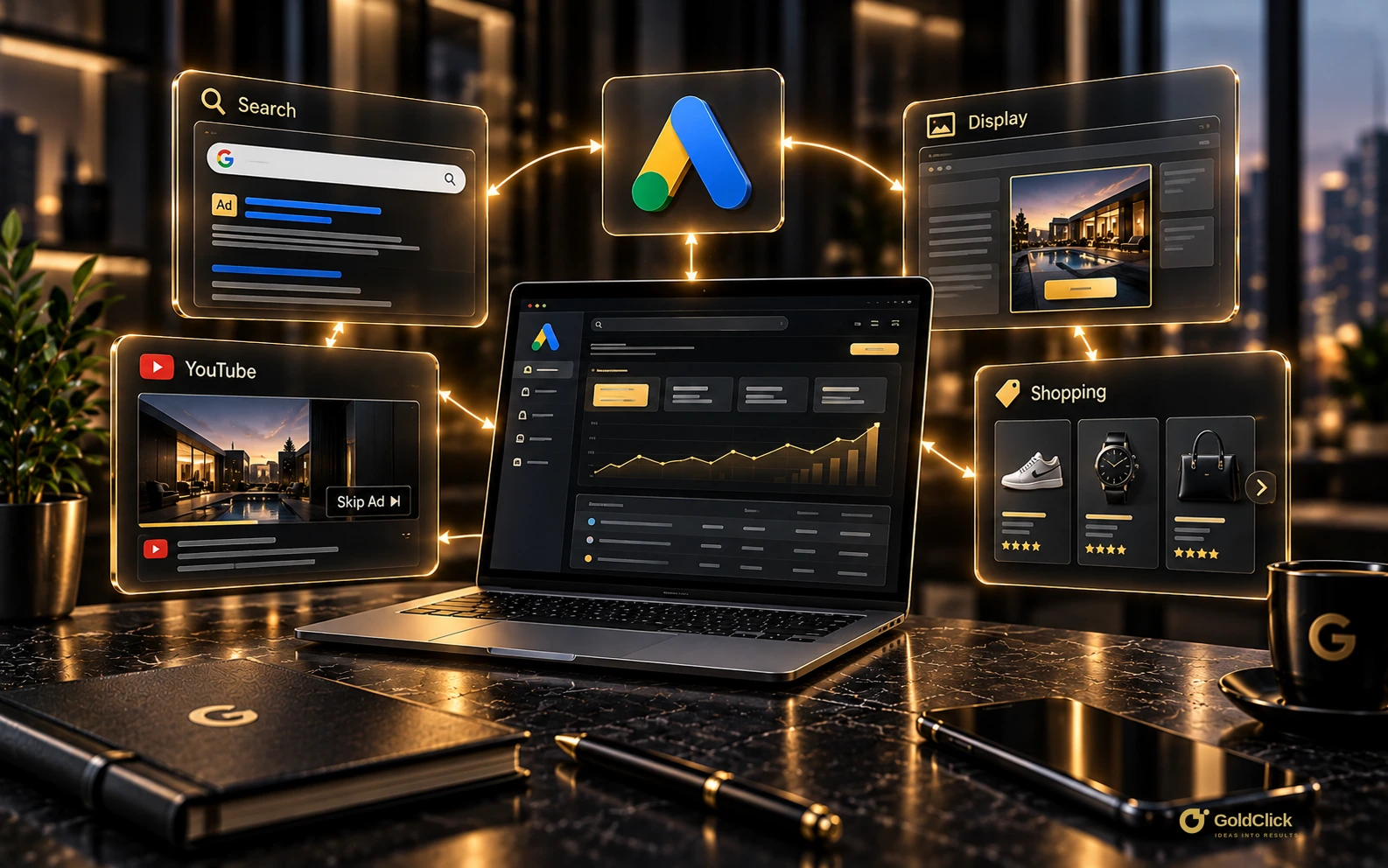
A useful Search campaign groups closely related services and sends each group to a landing page that directly matches what the person is looking for. This makes the ad, page content and next action consistent and gives the budget a better chance of reaching people with commercial intent.
Negative keywords, location settings, schedules and device behaviour are reviewed as part of that structure. The aim is not to collect as many clicks as possible, but to reduce irrelevant traffic and concentrate spend where a realistic enquiry can happen.
Optimisation is unreliable when important actions are not measured. Depending on the project, useful conversions may include a submitted form, a phone-call click, a qualified lead event or another action that has clear business value.
We check that tracking is implemented consistently and that campaign decisions are not based only on impressions or click-through rate. When data quality is weak, improving measurement comes before making aggressive bidding changes.
There is no universal daily budget that is correct for every business. The practical starting point depends on market demand, geographic reach, click costs, the number of services being promoted and how much data is needed before decisions become meaningful.
Ongoing management includes search-term review, negative keywords, bids, ad assets, landing-page alignment and conversion quality. Budget increases make sense only when the campaign structure and lead quality justify them.
Paid search can generate visibility immediately while SEO develops over a longer period. The two channels are managed separately, but they can inform the same business decisions: which services deserve dedicated pages, where the offer is unclear and which landing pages convert relevant traffic effectively.
Using both does not mean duplicating the same message everywhere. Organic pages can provide broader explanation, while advertising landing pages can stay tightly focused on one offer and one next step.
A Google Ads account is easier to optimise when campaigns and ad groups reflect distinct commercial intents. We separate services, locations or product groups where the search behaviour and landing-page message genuinely differ, rather than placing unrelated terms into one campaign simply for convenience. This makes budgets, negatives and conversion results easier to interpret.
Account structure should not become unnecessarily granular either. Very small ad groups with no meaningful data can slow learning and create maintenance overhead. The right level of detail is the one that allows different intent to be controlled without fragmenting volume for no reason.
Keywords define how the advertiser enters auctions, but the actual search terms show what people typed. We review those terms to find irrelevant traffic, new useful variants and cases where match behaviour is broader than expected. Negative keywords are then added carefully so they reduce waste without blocking valuable long-tail demand.
This review is continuous because search behaviour changes and broad matching can discover new combinations over time. A campaign that looked clean at launch can drift if search terms, products or business priorities are not revisited.
The click is only the beginning of the conversion path. A landing page should confirm the service, location, benefit and next step promised by the ad. If every campaign sends visitors to a generic homepage, users have to repeat their search inside the site and conversion data becomes harder to interpret.
We look at headline consistency, mobile layout, page speed, proof, price context where appropriate, form friction and calls to action. A stronger landing page can improve results without increasing media spend because more of the existing qualified traffic reaches a useful business action.
Before increasing budget or relying on automated bidding, primary conversions need to represent real value: completed lead forms, qualified phone actions, purchases or another agreed business outcome. Secondary events can help diagnose behaviour, but they should not be mixed with primary goals if that would teach bidding systems to optimise for easy but low-value actions.
Tags and imported events are tested for duplicates, missing triggers and changes after website updates. If a redesign changes form behaviour or thank-you URLs, tracking is revalidated rather than assumed to continue working.
There is no universal minimum budget that makes every campaign viable. Useful spend depends on how often relevant searches occur, auction costs, geography, number of services and the rate at which clicks become qualified enquiries. A limited budget is often better concentrated on the highest-priority intent than spread thinly across every possible service.
We evaluate cost per conversion and lead quality alongside CPC. Cheap clicks are not an advantage if they rarely produce business, while an expensive query can be rational when it consistently generates valuable work. Budget changes are made with that economic context.
Search terms, device and location performance, schedules, ads, landing pages and bidding can all be adjusted, but changing everything at once makes the result difficult to attribute. We prioritise the largest credible source of waste or opportunity, make the change and then allow enough data to evaluate it.
Automated recommendations are reviewed rather than applied blindly. Some suggestions can help, but account-specific goals, margins, sales capacity and conversion quality matter more than a platform optimisation score.
Paid search can create immediate presence for selected commercial queries as long as budget is available. SEO builds organic visibility more gradually through technical quality, structure, content and authority. A business does not have to choose one permanently; the channels can support different stages of growth.
Ads can also reveal which messages, services and landing pages convert efficiently, while SEO can reduce long-term dependence on paid clicks for topics where the business earns strong organic visibility. We keep measurement separate enough to understand each channel while using the combined evidence to improve the website.
Practical answers to questions that usually affect scope, risk, timing and the decision to start.
For Google Ads, start with the business goal, target audience, ownership of existing assets and the expected scope. We then translate those requirements into priorities around campaign structure, search intent and ad groups and ads. Clear inputs reduce rework and make the final scope easier to price and test.
For Google Ads, the scope follows the actual work required rather than a fixed checklist. We define deliverables, responsibilities, dependencies and acceptance criteria before implementation. Items such as negative keywords, landing pages or conversion tracking are included when they are relevant to the project.
There is no universal duration for Google Ads. Timing depends on the amount of content, technical complexity, access to existing systems, feedback cycles and whether migration or integration work is required. We prefer to define milestones and dependencies instead of promising a date that ignores the real scope.
For Google Ads, quality control combines functional review with the signals that matter for the project. Depending on the service we may check qualified conversions, cost per conversion, conversion rate and related technical conditions. The goal is to find issues before they become expensive after launch.
For Google Ads, common problems include sending all traffic to the homepage, optimising for clicks instead of business actions and running without conversion tracking. We try to identify these early, document important decisions and avoid changes that have no clear business or technical reason.
Yes. For Google Ads, Landing Pages, conversion tracking and SEO can be planned together, but the primary scope remains clear so one page or project does not try to solve every digital problem at once.
Explore “Google ads management” when it is the next logical step for the project, with scope and priorities defined around the business goal rather than added as an isolated extra.
Learn more →Explore “Google ads” when it is the next logical step for the project, with scope and priorities defined around the business goal rather than added as an isolated extra.
Learn more →Explore “Google ads budget” when it is the next logical step for the project, with scope and priorities defined around the business goal rather than added as an isolated extra.
Learn more →Explore “Google ads conversion tracking” when it is the next logical step for the project, with scope and priorities defined around the business goal rather than added as an isolated extra.
Learn more →Explore “Landing page development” when it is the next logical step for the project, with scope and priorities defined around the business goal rather than added as an isolated extra.
Learn more →You do not need to know the technical terminology. Tell us about your business, target customers and goal; we will propose a practical next step.